I was 28 when a doctor first said the word Hashimoto's to me. I remember two feelings, in this order: relief — because the exhaustion finally had a name — and then, over the months that followed, a slower, stranger feeling. The treatment was working on paper. And I still felt like a stranger in my own body.
If you have Hashimoto's, you may know exactly the appointment I mean. The one where your levothyroxine dose has done its job, your TSH has settled into range, and your doctor looks up from the screen and says the sentence this entire article is about:
“Your labs are normal. Everything looks fine.”
I don't blame that doctor. By the standard playbook, they were right. Thyroid hormone replacement is the correct, evidence-based treatment for Hashimoto's, and I want to say this clearly before anything else: I take my medication, and nothing in this story is a suggestion to change yours.
But “your labs are normal” and “you are fine” are not the same sentence. At 3pm I was fighting to keep my eyes open. Words I knew were suddenly out of reach in meetings. I was cold in rooms where everyone else was comfortable. And every test kept coming back reassuring.
When I described this, I heard the explanations many of you have heard: stress. Sleep hygiene. Maybe mild depression. One practitioner suggested I was simply getting older. I was twenty-eight.
Clément Gomis, diagnosed with Hashimoto's at 28. He still takes his levothyroxine.
But “your labs are normal” and “you are fine” are not the same sentence.
The question nobody was asking
I'm not a doctor. I was a patient with a scientific bent, an evening routine, and a growing folder of PDFs. So I started where anyone can start: the published literature. Not wellness blogs — actual peer-reviewed research on autoimmune thyroiditis. It took the better part of two years, and a collaboration with a research scientist, to organize what I found into something usable.
The question that unlocked it for me was this: replacement gives you T4 — but what does your body need to actually use it?
Levothyroxine is T4, a storage form. The energy you feel — or don't — depends largely on T3, the active form, which your body converts from T4. That conversion runs on specific nutritional cofactors, selenium and zinc among them. Meanwhile, an autoimmune thyroid sits in a state of chronic oxidative stress, drawing down antioxidant reserves. And the B-vitamin machinery behind steady energy — the methylation cycle — depends on folate and B12 in their active forms, which a meaningful share of people convert inefficiently from the synthetic versions.
None of this is fringe. Selenium's role in thyroid function has been studied in randomized trials for over two decades. The T4-to-T3 conversion pathway is textbook endocrinology. What surprised me wasn't the science. It was that nobody had ever mentioned any of it to me — and that the multivitamin sitting in my kitchen addressed almost none of it.
Selenium, zinc, magnesium, active B vitamins — the cofactors this section describes are exactly what Core Axis is built from. See the full formulation →
The label that made me angry
I still remember reading that label properly for the first time. Folic acid — the synthetic form my MTHFR variant handles poorly. Cyanocobalamin — a B12 form my body would need to convert twice. Selenium at a dose that looked like a rounding error next to what the clinical trials used. And kelp-derived iodine — an ingredient that people with autoimmune thyroid conditions are commonly advised to be cautious with.
It wasn't a bad product. It was a product built for the general population — for preventing deficiencies in healthy people. I wasn't a healthy person with a mild deficiency. I was a person whose immune system was attacking his thyroid. The tool and the problem didn't match.
What to check
Typical thyroid formula
Typical multivitamin
Core Axis
Iodine / kelp
Often the first ingredient
Usually included
None
Folate form
Folic acid
Folic acid
L-5-MTHF
B12 form
Cyanocobalamin
Cyanocobalamin
Methylcobalamin
Selenium
25–50 µg, or none
~25 µg
100 µg
Doses disclosed
Often hidden in a blend
Listed
Every one, on the label
Per-lot testing
Varies
Varies
Eurofins, COAs public
What to checkCore Axis
Iodine / kelpNone
Thyroid formula
Often the first ingredient
Multivitamin
Usually included
Folate formL-5-MTHF
Thyroid formula
Folic acid
Multivitamin
Folic acid
B12 formMethylcobalamin
Thyroid formula
Cyanocobalamin
Multivitamin
Cyanocobalamin
Selenium100 µg
Thyroid formula
25–50 µg, or none
Multivitamin
~25 µg
Doses disclosedEvery one, on the label
Thyroid formula
Often hidden in a blend
Multivitamin
Listed
Per-lot testingEurofins, COAs public
Thyroid formula
Varies
Multivitamin
Varies
“Typical” describes formulas commonly found in this category, not every product. Check your own label.
“The formula is fully transparent. That is rare.”
Laura L. · Member · Hashimoto since 2022
No folic acid, no cyanocobalamin, no kelp, no proprietary blend. Every dose printed. See what's inside →
Free 2-page PDF
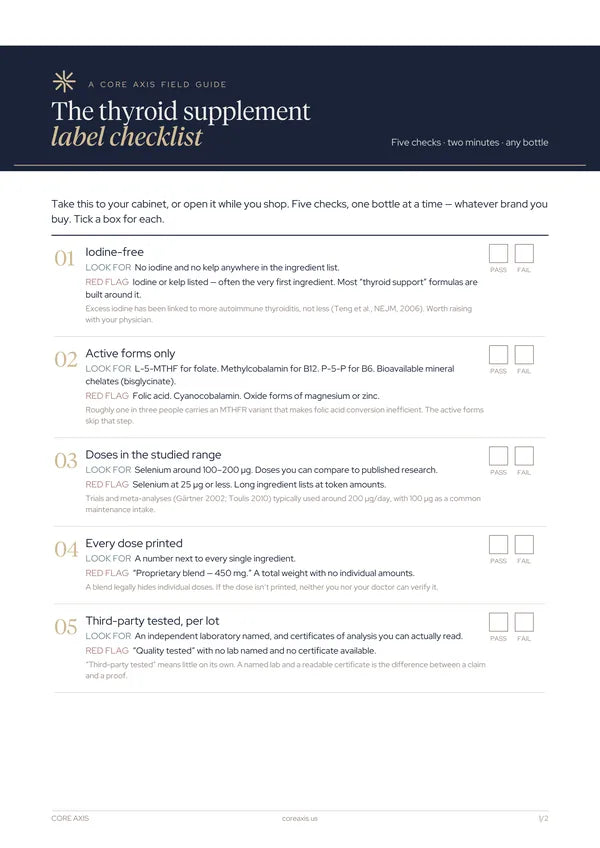
Check your own bottle in two minutes.
The ingredient most thyroid formulas are built around, and why to skip it
The selenium dose used in the research
The B vitamin forms to look for, and the ones to avoid
Plus a few emails from Clement on living with Hashimoto's. Unsubscribe anytime.
Building what I couldn't find
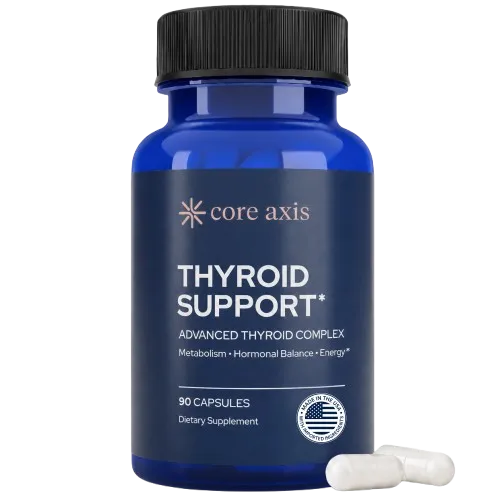
I looked for a formula built specifically for Hashimoto's: iodine-free, active forms only, at the doses the studies actually used, with every amount printed on the label. I couldn't find one that checked every box. So — with Elena Vayndorf, Ph.D., a research scientist whose day job is aging biology — I spent the next chapter of this story building it. Ten actives. Three capsules, once a day, four hours away from my levothyroxine. Every dose disclosed, every lot third-party tested.
I won't tell you it changed everything overnight, because it didn't, and because that's not how nutrition works. What I noticed, somewhere in the first several weeks, was quieter: the 3pm wall stopped arriving at 3pm. Words came back. I stopped planning my life around my energy. That's my experience — not a promise, and individual results vary. But it's why Core Axis exists.
Ten actives, three capsules a day, four hours apart from levothyroxine. See the protocol →
If this story sounds like yours
Three things I wish someone had told me at that appointment:
1. You're not imagining it. The gap between normalized labs and persistent symptoms is documented, discussed in the endocrinology literature, and lived by a very large number of people — most of them women, many of them dismissed.
2. Keep your doctor, and keep your medication. Nothing nutritional replaces either. The right frame is and, not instead of.
3. Ask what your protocol is actually made of. Forms, doses, and what's left out (like iodine) matter more than the length of the ingredient list. If the label doesn't disclose everything, that's an answer too.
We built Core Axis for one condition, one persona, one job: giving the autoimmune thyroid's support system the raw materials the research points to — nothing more, nothing less. It isn't for everyone. That's the point.
What the first 90 days look like
WEEKS 1–2
Groundwork
Your body replenishes the mineral and B-vitamin cofactors that daily thyroid demand runs down. Most members feel little yet. That is normal, and expected.
WEEKS 3–6
The window
When many members first notice steadier afternoons and less mental fog.
WEEKS 8–12
The full picture
The point where we recommend assessing honestly. With your physician, it is also a natural moment to revisit thyroid labs.
Individual results vary. Core Axis is a dietary supplement, not a treatment.
The Protocol · Choose your plan
$74.95
A drawer of half-finished bottles that didn't work: $150 and up. Core Axis, formulated for one condition: under $1 a day.
Included with your plan ✓
The Hashimoto's Protocol Guide — free
60-day money-back guarantee · Free US shipping · Skip or cancel anytime
Most members notice something between weeks 3 and 6. That window falls well inside the 60-day guarantee. If nothing has moved by then, you get every cent back.
Before you decide
Can I take this with levothyroxine?
Yes, four hours apart, which is standard practice for any mineral-containing supplement. Most members take levothyroxine on waking and Core Axis with lunch.
Is this a replacement for my medication?
No, and it never should be. Core Axis is designed to complement prescribed thyroid care, never to replace it. Don’t adjust prescribed medication on your own.
I’ve tried supplements before and nothing happened.
That’s the most common reason people hesitate, and it’s a fair one. Most multivitamins are engineered to prevent deficiencies in the general population: minimum doses, cheapest forms, something for everyone. Core Axis was formulated for one condition: different forms, different doses, everything disclosed so you can check the difference yourself.
What if I don’t feel anything?
You have 60 days, money back. The window where most members notice something falls inside it, so you can complete a meaningful stretch of the protocol and still change your mind.
* These statements have not been evaluated by the Food and Drug Administration. This product is not intended to diagnose, treat, cure, or prevent any disease.
This article is educational and is not medical advice. Always consult your physician.