The iodine mistake (and four more hiding on your supplement label)
Most “thyroid support” supplements are built for a generic thyroid, not an autoimmune one. Here are the five problems to check your label for, starting with the one that matters most.
Walk down any supplement aisle — physical or digital — and “thyroid support” looks like a solved problem. Dozens of formulas, thousands of reviews, the same promises. But Hashimoto's is not a generic thyroid problem: it's an autoimmune condition, and that difference changes what belongs in the bottle, and what absolutely doesn't.
Here are the five problems we see on thyroid supplement labels again and again. The first one is the reason this article exists.
1. The iodine mistake
If you've ever picked up a bottle labelled “thyroid support” and assumed it was made for a thyroid like yours, this is the section that matters most.
Iodine is essential for thyroid hormone production, in the right amount. That nuance is everything. Large population studies have observed that when iodine intake rises from adequate to excessive, autoimmune thyroiditis and subclinical hypothyroidism become more common, not less (Teng et al., New England Journal of Medicine, 2006). This is why people with Hashimoto's are commonly advised by clinicians to be cautious with high-dose iodine and kelp supplementation.
Now read the front label of most thyroid supplements: iodine or kelp is often the very first featured ingredient. These formulas were designed for iodine deficiency — a real problem in some populations — and then marketed to everyone with the word “thyroid” in their search history, including the millions whose thyroid condition is autoimmune.
What to check: does your thyroid formula contain iodine or kelp? If you have Hashimoto's, that's a conversation to have with your physician, and it's the first reason Core Axis was formulated iodine-free.
On most thyroid supplements, iodine isn't a minor ingredient. It's the first one on the label.
You took it every day for three months and felt nothing. Here's one reason that happens even when the ingredient list looks right.
Two B vitamins do heavy lifting in the energy and methylation pathways that Hashimoto's fatigue runs through: folate (B9) and B12. Most supplements use their cheapest versions — folic acid and cyanocobalamin — which your body must convert, in several enzymatic steps, into the forms it can use.
Here's the catch: studies suggest that roughly one in three people carries a variant of the MTHFR gene that makes folic acid conversion significantly less efficient. If you're one of them, a supplement can look complete on paper and still leave the pathway undersupplied. The bioavailable forms — L-5-MTHF for folate, methylcobalamin for B12 — skip the conversion problem entirely. They cost more, which is why most labels don't use them.
Core Axis uses L-5-MTHF and methylcobalamin: the forms your body doesn't have to convert. See what's inside →
3. Decorative doses
The label listed selenium. You checked. It was there. What you probably didn't check was how much.
Selenium is the single most-studied nutrient in autoimmune thyroid research: randomized trials and meta-analyses (Gärtner 2002; Toulis 2010) typically used around 200 µg per day, with 100 µg as a common maintenance intake. Now look at a standard multivitamin: selenium is often present at 25 µg or less. Enough to appear on the label. Not enough to resemble what was studied.
This pattern — the decorative dose — repeats across zinc, magnesium, and vitamin D. The ingredient list reads impressively; the milligrams tell another story. A label without disclosed doses per ingredient makes even that check impossible, which brings us to…
25µg
Typical multivitamin
100µg
In Core Axis
100–200µg
Range used in studies
Selenium per daily serving. Study range per Gärtner 2002 and Toulis 2010; multivitamin figure is typical of standard formulas, not universal.
“Finally something that works at the right dose.”
Sofia R. · Member · Hashimoto since 2020
100 µg of selenium, the dose the studies actually used. Every dose printed on the label. See the label →
4. The proprietary blend curtain
This community teaches you to read labels carefully. This is the one designed to stop you.
“Proprietary Thyroid Complex — 450 mg.” Of what? In what amounts? A proprietary blend legally allows a brand to disclose the total weight of a mixture without revealing individual doses. It's presented as protecting a secret formula. In practice, it makes it impossible for you — or your doctor — to verify whether any single ingredient reaches a meaningful dose.
Our position is simple: if the dose isn't printed, assume it's decorative. Every Core Axis dose is on the label, with the studies that informed it cited on our formulation page, not because we're generous, but because label transparency is the only way an informed patient can comparison-shop at all.
“The formula is fully transparent. That is rare.”
Laura L. · Member · Hashimoto since 2022
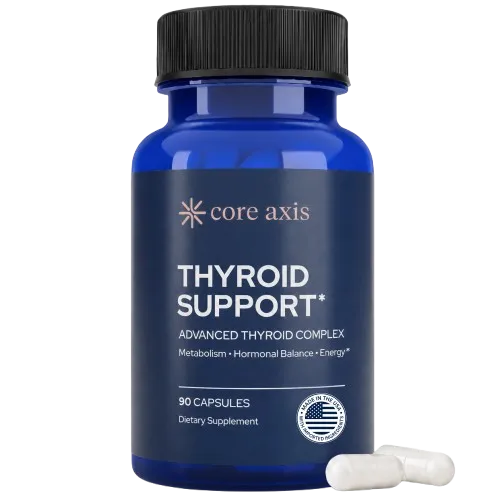
No proprietary blends: ten actives, ten disclosed doses, certificates published for every lot. See the formulation →
Free 2-page PDF
Check your own bottle in two minutes.
The ingredient most thyroid formulas are built around, and why to skip it
The selenium dose used in the research
The B vitamin forms to look for, and the ones to avoid
Plus a few emails from Clement on living with Hashimoto's. Unsubscribe anytime.
5. Built for deficiency, marketed for autoimmunity
If you've done everything you were told to do and still feel like nothing works, this section is why.
The deepest problem isn't any single ingredient — it's the design brief. A multivitamin is engineered to prevent deficiencies in the general population: minimum effective doses, cheapest acceptable forms, something for everyone. Hashimoto's presents a different problem: an immune system attacking the thyroid, chronic oxidative stress, a T4-to-T3 conversion pathway that runs on specific cofactors (selenium, zinc, magnesium), and a methylation cycle under demand. Same aisle, different job.
That mismatch is why so many people with Hashimoto's have a drawer of half-finished supplement bottles and the sense that “nothing works.” Often, nothing was designed to.
What a Hashimoto's-specific label looks like
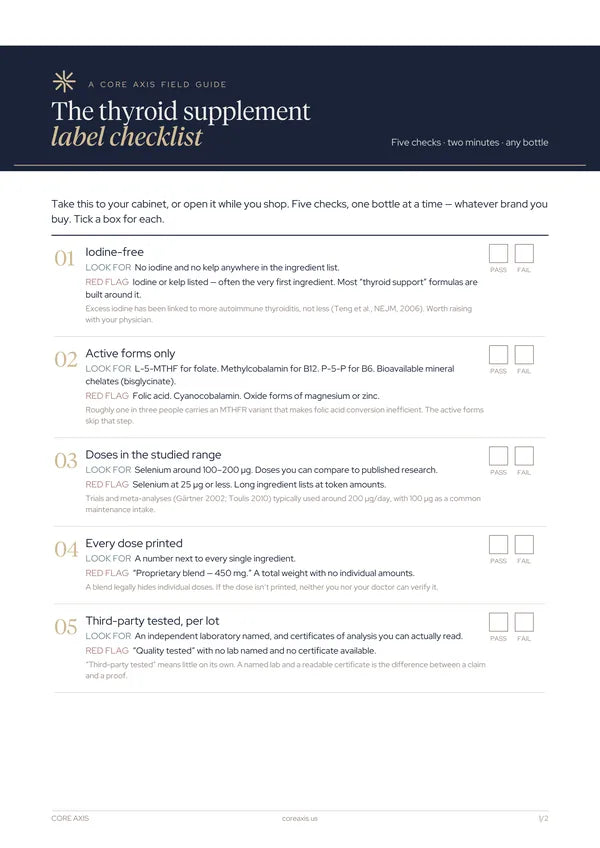
If you take one thing from this article, make it this checklist. Whatever brand you buy, look for:
Iodine-free — no iodine, no kelp, discussed with your physician
Active forms — L-5-MTHF (not folic acid), methylcobalamin (not cyanocobalamin), P-5-P, bioavailable mineral chelates
Clinical-range doses, printed — e.g., selenium at 100–200 µg, not 25 µg (Gärtner 2002; Toulis 2010)
Zero proprietary blends — every dose visible, every claim referenced
Per-lot third-party testing — with certificates you can actually read
We built Core Axis to pass this exact checklist, for one condition, deliberately: ten actives, three capsules a day, taken four hours apart from thyroid medication. But even if you never buy from us: take the checklist. Flip your bottle. Read the label the way this community has learned to read everything else — carefully, and on your own behalf.
What to check
Typical thyroid formula
Typical multivitamin
Core Axis
Iodine / kelp
Often the first ingredient
Usually included
None
Folate form
Folic acid
Folic acid
L-5-MTHF
B12 form
Cyanocobalamin
Cyanocobalamin
Methylcobalamin
Selenium
25–50 µg, or none
~25 µg
100 µg
Doses disclosed
Often hidden in a blend
Listed
Every one, on the label
Per-lot testing
Varies
Varies
Eurofins, COAs public
What to checkCore Axis
Iodine / kelpNone
Thyroid formula
Often the first ingredient
Multivitamin
Usually included
Folate formL-5-MTHF
Thyroid formula
Folic acid
Multivitamin
Folic acid
B12 formMethylcobalamin
Thyroid formula
Cyanocobalamin
Multivitamin
Cyanocobalamin
Selenium100 µg
Thyroid formula
25–50 µg, or none
Multivitamin
~25 µg
Doses disclosedEvery one, on the label
Thyroid formula
Often hidden in a blend
Multivitamin
Listed
Per-lot testingEurofins, COAs public
Thyroid formula
Varies
Multivitamin
Varies
“Typical” describes formulas commonly found in this category, not every product. Check your own label.
Core Axis was built to pass this checklist: iodine-free, active forms, clinical doses, every ingredient disclosed.
What the first 90 days look like
WEEKS 1–2
Groundwork
Your body replenishes the mineral and B-vitamin cofactors that daily thyroid demand runs down. Most members feel little yet. That is normal, and expected.
WEEKS 3–6
The window
When many members first notice steadier afternoons and less mental fog.
WEEKS 8–12
The full picture
The point where we recommend assessing honestly. With your physician, it is also a natural moment to revisit thyroid labs.
Individual results vary. Core Axis is a dietary supplement, not a treatment.
The Protocol · Choose your plan
$74.95
A drawer of half-finished bottles that didn't work: $150 and up. Core Axis, formulated for one condition: under $1 a day.
Included with your plan ✓
The Hashimoto's Protocol Guide — free
60-day money-back guarantee · Free US shipping · Skip or cancel anytime
Most members notice something between weeks 3 and 6. That window falls well inside the 60-day guarantee. If nothing has moved by then, you get every cent back.
Yes, four hours apart, which is standard practice for any mineral-containing supplement. Most members take levothyroxine on waking and Core Axis with lunch.
Is this a replacement for my medication?
No, and it never should be. Core Axis is designed to complement prescribed thyroid care, never to replace it. Don’t adjust prescribed medication on your own.
I’ve tried supplements before and nothing happened.
That’s the most common reason people hesitate, and it’s a fair one. Most multivitamins are engineered to prevent deficiencies in the general population: minimum doses, cheapest forms, something for everyone. Core Axis was formulated for one condition: different forms, different doses, everything disclosed so you can check the difference yourself.
What if I don’t feel anything?
You have 60 days, money back. The window where most members notice something falls inside it, so you can complete a meaningful stretch of the protocol and still change your mind.
* These statements have not been evaluated by the Food and Drug Administration. This product is not intended to diagnose, treat, cure, or prevent any disease.
This article is educational and is not medical advice. Always consult your physician.